
谢谢 Xiexie: How to use thank you in Chinese
By Liu ZhiyuBeginner, HSK2March 5, 2025
Quick Summary: In China, saying "thank you" too much can actually make you sound like a stranger. Master the authentic scenarios, variations, and cultural rules of 谢谢 (xiè xie).
For most foreign learners learning Chinese, 谢谢 (xiè xie) is one of the first words they memorize. However, countless learners only know its basic meaning of “thank you” but often use it improperly in real life.
Unlike English, where “thank you” is fixed and universal, Chinese gratitude expressions change drastically based on age, relationship, occasion, and cultural norms. Overusing “谢谢” can sound distant and awkward, while underusing it may seem impolite.
This article systematically explains the basic usage, authentic scenario-based expressions, and unique cultural connotations of “谢谢”, helping you speak natural, polite, and culturally correct Chinese.
1. Basic Usage of 谢谢 (Core Knowledge for Beginners)
Before learning advanced expressions, you must master the standard pronunciation, core definition, and basic sentence structures of 谢谢 — the foundation of all gratitude communication.
1.1 Standard Pronunciation & Tone Rules
谢谢 (xiè xie)
- First 谢: 4th tone (falling tone), clear and definite
- Second 谢: neutral tone (light and soft, no stress)
Common learner mistake: Pronouncing both characters in the 4th tone. This sounds stiff and robotic, not like native speaking.
1.2 Core Meaning & Word Variations
Literally, 谢谢 means “to thank”. It is the universal word for expressing gratitude in Chinese. By adding simple pronouns, we can form three basic fixed usages suitable for most daily situations:
- 谢谢 = Thanks / Thank you (neutral, general use)
- 谢谢你 (xiè xie nǐ) = Thank you (casual, for peers, friends, people of the same age)
- 谢谢您 (xiè xie nín) = Thank you (polite & respectful, for elders, teachers, strangers, superiors)
1.3 Basic Sentence Structures
Chinese usually puts the reason for gratitude before 谢谢, which is different from English word order:
- English: Thank you for your help.
- Chinese: 谢谢你的帮助 (Thank you for your help)
- Chinese: 谢谢你告诉我 (Thank you for telling me)
Key rule: In formal scenarios, always replace 你 with 您 to show respect.
2. Authentic Scenario-Based Expressions of “Thank You”
Native Chinese speakers do not rely solely on the basic “谢谢”. Different daily, social, and formal scenarios have exclusive authentic expressions. Using the right phrase in the right situation makes your Chinese natural and fluent.
2.1 Casual Daily Scenarios (Friends, Classmates, Colleagues of Equal Status)
For small favors in daily life (borrowing items, casual help, simple kindness), too formal “谢谢” will create a sense of distance.
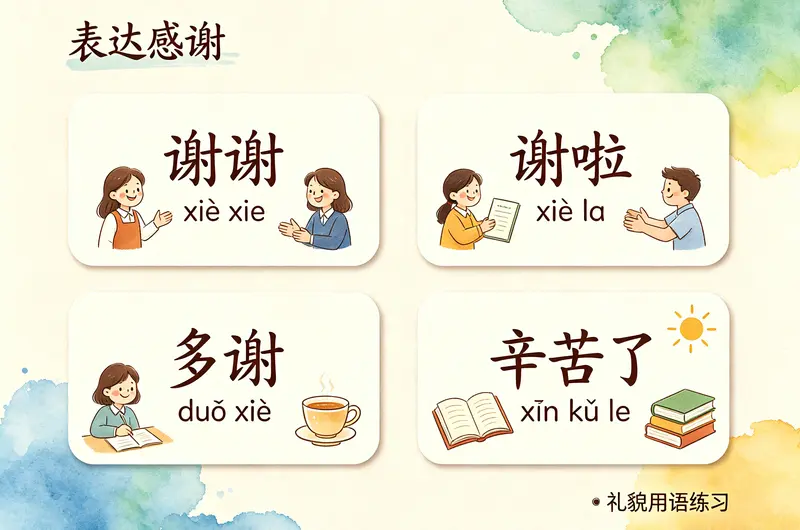
- 谢啦 (xiè la) = Thx! / Thanks a lot (casual, warm)
- 多谢 (duō xiè) = Many thanks (simple and friendly)
Scenario example: A friend hands you a bottle of water or helps you take a delivery → Say 谢啦 (best choice).
Cultural tip: Between close family members and best friends, Chinese people rarely say “谢谢”. Frequent thanks will make the relationship seem unfamiliar and estranged.
2.2 Formal & Public Scenarios (Teachers, Elders, Customers, Strangers)
In formal occasions, we need upgraded expressions to show sincerity and etiquette:
- 非常感谢您 = Thank you very much / I highly appreciate it
- 十分感谢您的帮助 = I sincerely appreciate your help
Scenario example: A teacher answers your questions patiently, a stranger offers important help, or you communicate with clients → Use formal gratitude phrases.
2.3 Special Scenario: Thanks for Hard Work (Unique Chinese Expression)
This is the most commonly used and most easily misunderstood expression by foreign learners:
辛苦了 (xīn kǔ le) = You’ve worked hard!
It is essentially a way of expressing gratitude in Chinese, with no direct equivalent in English.
Applicable scenarios: When others spend time and energy helping you, working for you, or serving you (cleaners, drivers, teachers, colleagues finishing group work).
Example: After a meeting or group project, Chinese people usually say 大家辛苦了,谢谢大家 (Everyone has worked hard, thank you all).
2.4 Reply to “Thank You” (Matching Authentic Dialogue)
To complete the communication, you need to master standard replies:
- 不客气 (bù kè qì) = You’re welcome (universal, formal & casual)
- 不用谢 (bù yòng xiè) = No problem / Don’t mention it (casual)
- 应该的 (yīng gāi de) = It’s my pleasure / It’s what I should do (modest, workplace daily use)
3. Deep Cultural Connotation of Chinese “谢谢”
The biggest difference between Chinese and Western gratitude lies in culture and interpersonal logic. Understanding these connotations will help you avoid cultural mistakes and integrate into Chinese communication better.
3.1 Gratitude in China Is “Hierarchical & Relational”
In English-speaking countries, “thank you” is an equal, universal polite word for almost everyone. In China, gratitude language strictly follows seniority and social status:
- We use 您 for respect (elders, superiors, strangers)
- We use casual expressions for peers
- We omit thanks for close family and intimate friends
This comes from traditional Chinese etiquette: politeness is reflected in distinguishing closeness and hierarchy, not rigid uniformity.
3.2 Less Thanks = Closer Relationship (Core Cultural Difference)
This is the biggest cultural shock for foreign learners.
In Western culture, saying “thank you” frequently is basic politeness, even to family and lovers.
In Chinese culture: Too many thanks between close people mean estrangement.
Chinese interpersonal relationships emphasize tacit understanding and mutual affection. For family members and best friends, help is based on affection, not etiquette. Repeatedly saying “谢谢” will make others feel you are treating them as a stranger.
3.3 Chinese Gratitude Emphasizes “Sincerity Over Formality”
Western gratitude tends to be verbal and formulaic. Chinese gratitude is subtle and practical.
Native Chinese people rarely use exaggerated thanks in daily life. A simple “谢谢” or “辛苦了” is enough to show sincerity. Meanwhile, Chinese people prefer to repay kindness with practical actions rather than only verbal thanks, which reflects the traditional Chinese virtue of gratitude and reciprocity.
3.4 Politeness Modesty: The Hidden Logic of “谢谢”
When Chinese people say “谢谢”, they not only express gratitude, but also convey modesty and respect.
Replying with “应该的” is not perfunctory, but a typical Chinese modesty culture — downplaying one’s own contribution and affirming the other’s recognition, which maintains a harmonious interpersonal atmosphere.
4. Final Summary for Learners
1. Basic rule: 谢谢 (xiè xie) = general thanks; 谢谢你 for peers; 谢谢您 for respect.
2. Scenario rule: Casual for friends, formal for elders/strangers, 辛苦了 for hard work scenarios.
3. Cultural rule: Thanks are for strangers and ordinary relationships. Less verbal thanks represent closer intimate relationships in China.