
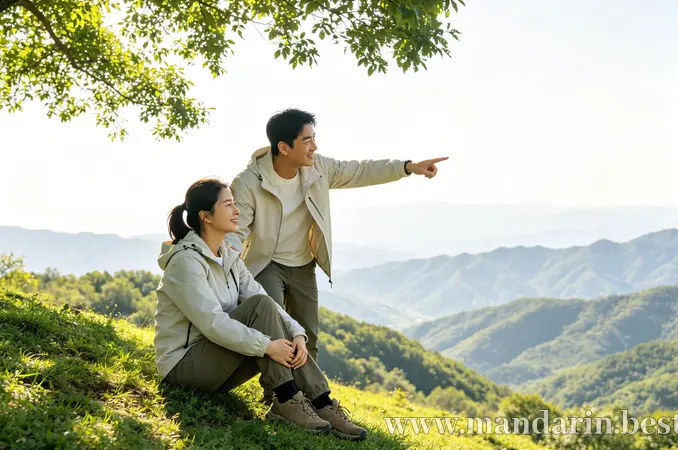
小丽
休息一下吧。
小刚
怎么了?走不动了?
小丽
我现在腿也疼,脚也疼,下山比上山累多了。
小刚
那我们过去坐一下吧,那边树多,凉快,再喝点水。
小丽
上来的时候我怎么没觉得这么累?
小刚
上山容易下山难,你不知道?
怎么zěn me
how?
一下yī xià
[used after a verb] give something a go
容易róng yì
easy
时候shí hòu
[duration of] time
休息xiū xī
to rest
过去guò qù
(in the) past
觉得jué de
to think; feel
我们wǒ men
we; us
下山xià shān
Go down the mountain
上山shàng shān
Go up the mountain
走不动zǒu bù dòng
Can't walk
我现在腿也疼,脚也疼,下山比上山累多了
wǒ xiàn zài tuǐ yě téng , jiǎo yě téng , xià shān bǐ shàng shān lèi duō le
My legs and feet hurt now. Going down the mountain is much more tiring than going up.
那我们过去坐一下吧,那边树多,凉快,再喝点水
nà wǒ men guò qù zuò yī xià ba , nà biān shù duō , liáng kuài , zài hē diǎn shuǐ
Then let's go over and sit for a while. There are many trees over there and it's cool. Let's drink some water.
上来的时候我怎么没觉得这么累
shàng lái de shí hòu wǒ zěn me méi jué de zhè me lèi
Why didn't I feel so tired when I came up?
结构助词 “的”|结构:N/P + 的 + N
我的书
wǒ de shū
my book
结构助词 “的”|结构:N/P + 的 + N
上山容易下山难,你不知道
shàng shān róng yì xià shān nán , nǐ bù zhī dào
It’s easy to go up the mountain but hard to go down, you don’t know
形容词谓语句:S + adv. of degree + adj. / S + 不 + adj.
苹果很大。
píng guǒ hěn dà 。
The apple is very big.
形容词谓语句:S + adv. of degree + adj. / S + 不 + adj.
我们早上七点上学。
wǒ men zǎo shàng qī diǎn shàng xué 。
We go to school at seven in the morning.
时间词做状语|结构:S + Time + V / Time + S + V
他怎么没来上课?
tā zěn me méi lái shàng kè ?
Why didn’t he come to class?
疑问代词 “怎么”|结构:怎么 + V/adj
🎯 Learning Goals
Структурная частица 的|Структура: N/P + of + N Прилагательное-сказуемое предложение: S + нареч. степени + прил. / S + не + прил. Слова времени как наречия|Структура: S + Time + V / Time + S + V. Вопросительное местоимение 怎么|Структура: How + V/прил.
Похожие статьи
12345678910
新年假期你准备做什么事情呢?
Что вы собираетесь делать во время новогодних каникул?
问路
Спросить дорогу
明天天气好可以出门跑步
Если завтра будет хорошая погода, ты можешь выйти на пробежку.
相约再次去中国游玩
Давайте встретимся, чтобы снова посетить Китай
忙碌的陈老师
Занятой учитель Чен
医院探望病人
Посещение пациентов в больнице
我要去北京旅行
Я собираюсь поехать в Пекин
我喜欢运动
Я люблю спорт
聊天气与日常状态
Чат о погоде и ежедневном статусе
快要下雨了路上慢一点
Будет дождь. Снижайте скорость на дороге.
上山容易下山难 · 全文朗读